Back to all modules Definitions: common terms, defined Search the tool

Pulse Academy | GovCon Mastery Tool
SAM Registration: Defense Response
SAM screens 74 to 79 of 92. One screen at a time: see it, learn it, practice it, then answer the screen check to mark the screen complete. Back and Next always work, so you can move in any order.
Screen 74: Defense Response: Section intro
This section holds the DFARS representations and certifications. DFARS is the Defense Federal Acquisition Regulation Supplement, the Defense Department's addition to the federal acquisition rules.
The intro addresses companies that intend to bid on, or currently hold, Defense Department issued or funded contracts.
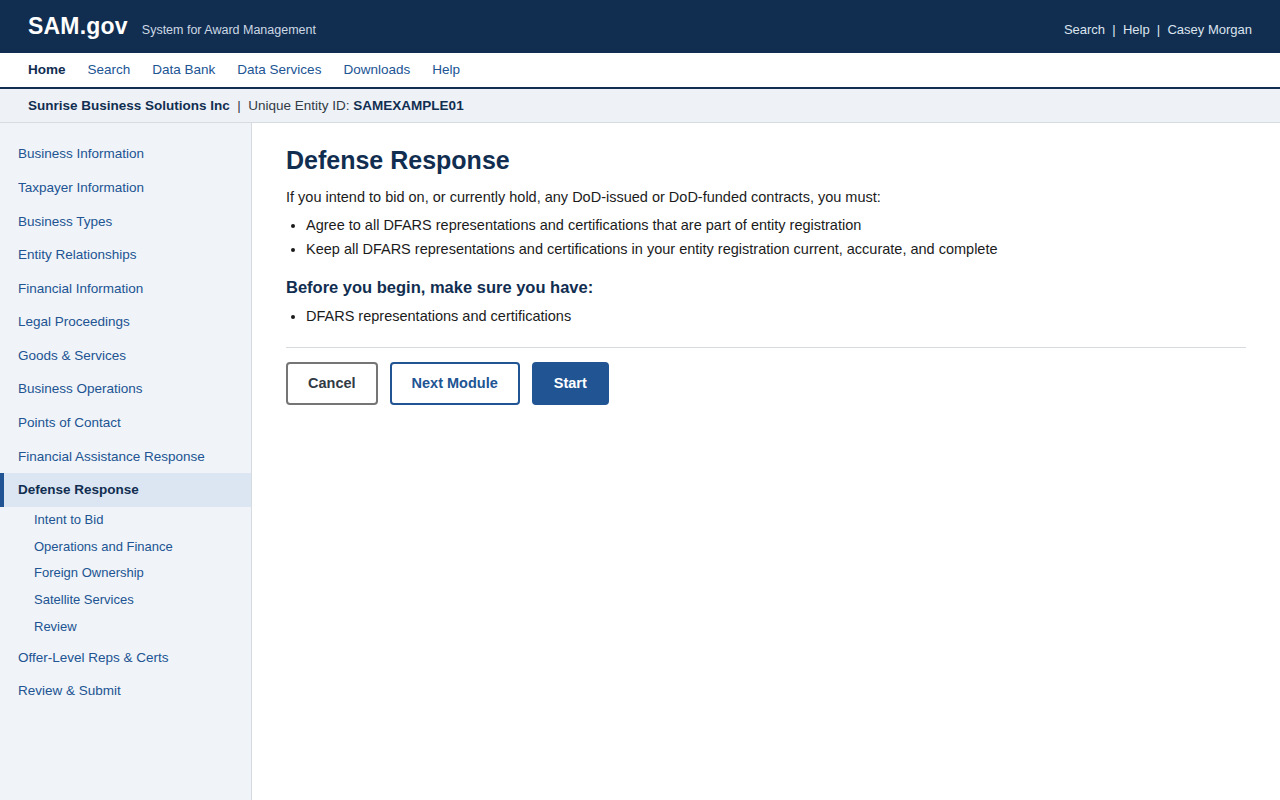
SAM.gov, Defense Response intro page
The page states the two duties for DoD bidders and lists what to have before you begin: the DFARS representations and certifications.
When you do this step for real, this is the screen waiting for you on the site. Read it over, then use the practice screen below to learn the step by doing it safely first.
Practice the duties. Check both once you understand them.
Check each duty this intro puts on a DoD (Department of Defense) bidder
A quick check on this one screen. Answer every question correctly to mark this screen complete. You can move on with Next at any time, finished or not, but the screen only counts as complete once its practice and this check are both done. You can try again if you miss one.
If you intend to bid on DoD contracts, what two duties does this intro put on you?
On the real intro, take the two duties seriously if you intend to bid on Defense Department work: agree to the DFARS representations and certifications, and keep them current, accurate, and complete.
Screen 75: Intent to Bid
This is the gateway question of the Defense Response: does your entity wish to bid on, or currently hold, any Department of Defense issued or funded contracts?
Your answer controls the rest of the section. Answer Yes, and questions 36 to 42 must be answered. Answer No, and those questions are recorded as Not Applicable.
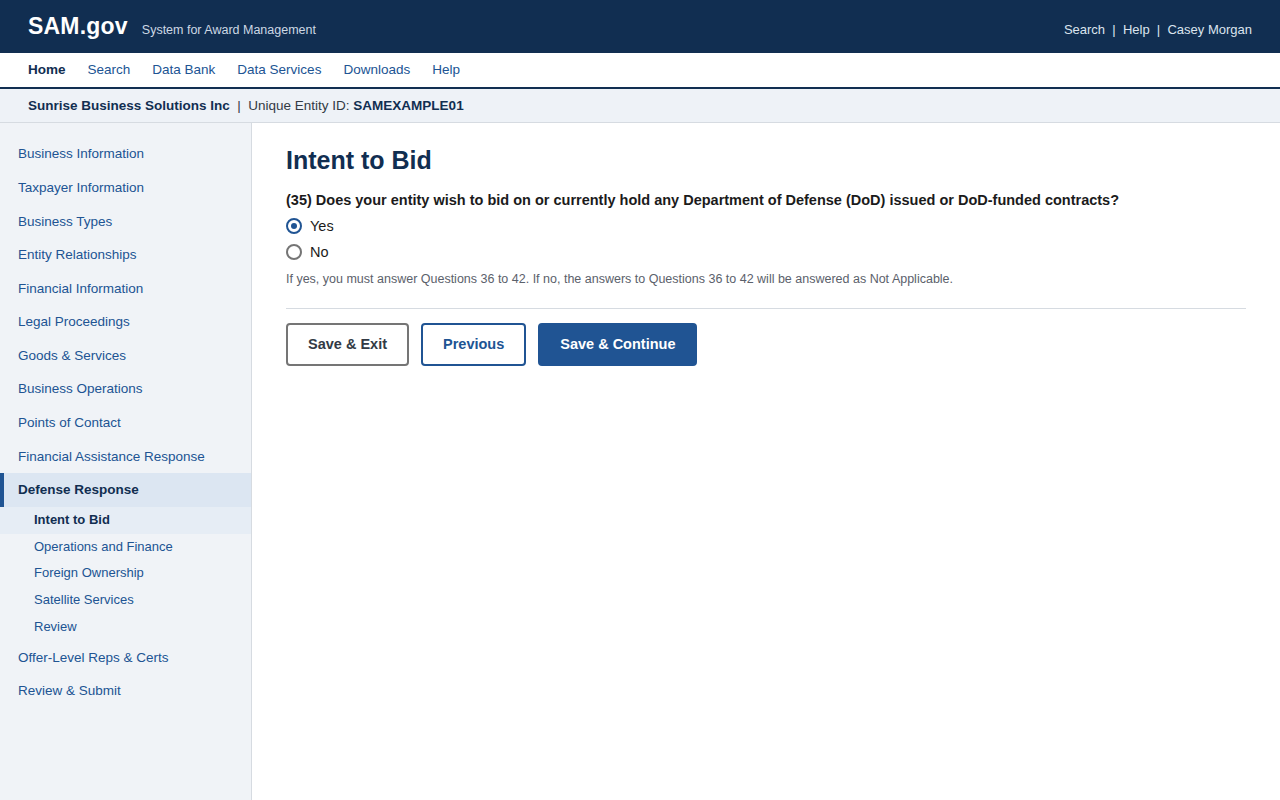
SAM.gov, Intent to Bid page
The gateway Yes or No question for the Defense Response section.
When you do this step for real, this is the screen waiting for you on the site. Read it over, then use the practice screen below to learn the step by doing it safely first.
“Does your entity wish to bid on or currently hold any Department of Defense (DoD) issued or DoD-funded contracts? (yes or no)” If yes, you must answer Questions 36 to 42. If no, the answers to questions 36 to 42 will be answered as Not Applicable.
The words above are the form text you will see, quoted from: Federal Service Desk (FSD) Entity Registration Checklist, Representations and Certifications, item 6, Defense Response, question 35. The teaching in this lesson is written in our own words.Practice for Sunrise. Practice fact: Sunrise does not bid on and does not hold Defense Department contracts. Answer the gateway for Sunrise.
Pick one: Does your entity wish to bid on or currently hold any Department of Defense (DoD) issued or DoD-funded contracts?
A quick check on this one screen. Answer every question correctly to mark this screen complete. You can move on with Next at any time, finished or not, but the screen only counts as complete once its practice and this check are both done. You can try again if you miss one.
What does answering No here do to the rest of this section?
A company has never bid on defense work, but it wants to bid on a DoD contract next year. What is its honest answer at this gateway?
On the real gateway, answer for your real ambitions: Yes if your entity wishes to bid on or holds DoD issued or funded contracts, which opens questions 36 to 42. No records those questions as Not Applicable and is the honest answer for a company with no defense plans.
Screen 76: Operations and Finance
Behind the gateway sit the DFARS questions about operations and finance. Two of them are covered here: sea transport of supplies, and pricing controlled by a foreign government.
These questions only require answers from companies that said Yes at Intent to Bid.
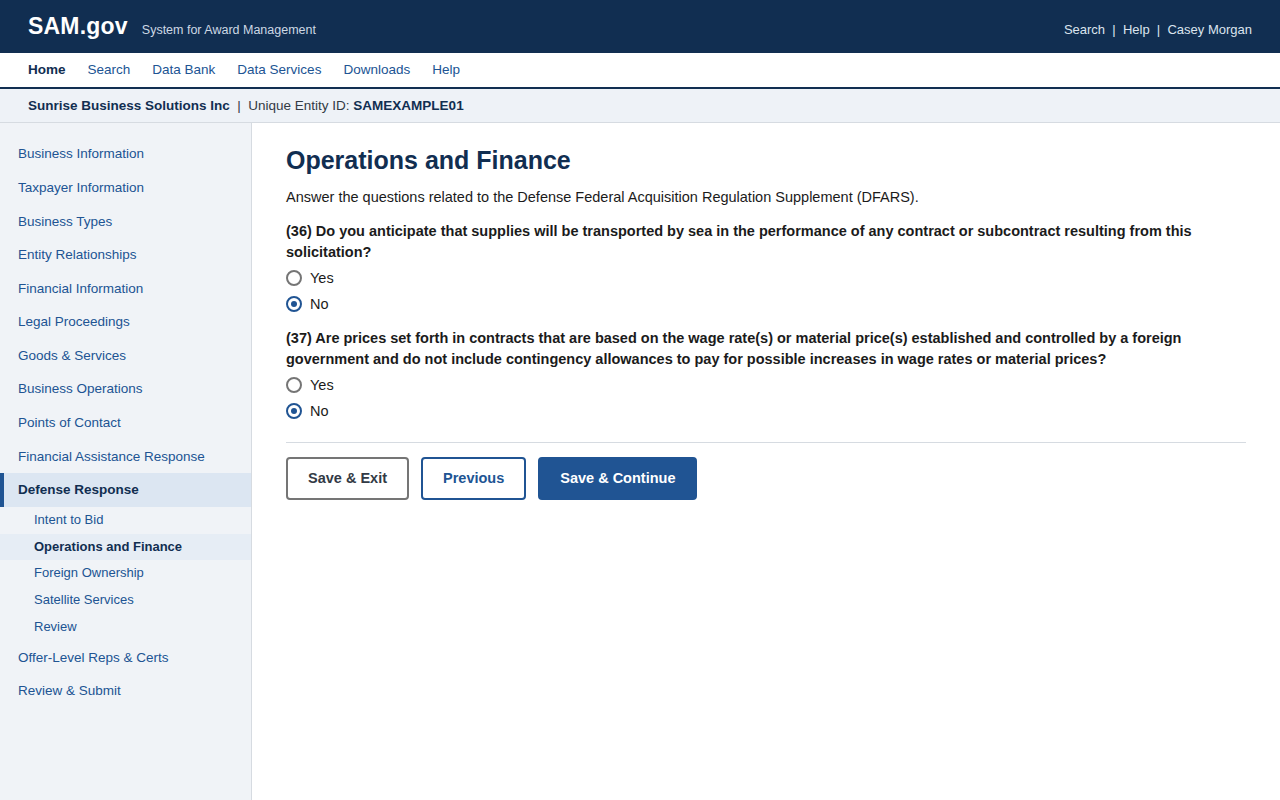
SAM.gov, Operations and Finance page
Yes or No DFARS representation questions, answered in the context of the DFARS provision at the end of the section.
When you do this step for real, this is the screen waiting for you on the site. Read it over, then use the practice screen below to learn the step by doing it safely first.
“Do you anticipate that supplies will be transported by sea in the performance of any contract or subcontract resulting from this solicitation? (yes or no)” And: “Are prices set forth in contracts that are based on the wage rate(s) or material price(s) established and controlled by a foreign government and do not include contingency allowances to pay for possible increases in wage rates or material prices? (yes or no)” If yes to the second, provide the name of the host country.
The words above are the form text you will see, quoted from: FSD Entity Registration Checklist, Defense Response, questions 36 and 37. The teaching in this lesson is written in our own words.Practice under a supposition: imagine a company that answered Yes at Intent to Bid. It is a U.S. ambulance company: no sea transport of supplies, and its prices are set by itself, not by any foreign government. Answer both questions for it.
Pick one: Do you anticipate that supplies will be transported by sea in the performance of any contract or subcontract resulting from this solicitation?
Pick one: Are prices set forth in contracts based on wage or material prices established and controlled by a foreign government, without contingency allowances?
A quick check on this one screen. Answer every question correctly to mark this screen complete. You can move on with Next at any time, finished or not, but the screen only counts as complete once its practice and this check are both done. You can try again if you miss one.
Which of these two questions requires a follow-up entry if you answer Yes, and what entry?
An ordinary U.S. services company sets its own prices and moves everything by road. What does it answer to questions 36 and 37?
On the real questions, answer from your real operations: whether supplies will move by sea, and whether a foreign government controls your contract prices. A Yes on pricing requires the host country's name.
Screen 77: Foreign Ownership (Defense Response)
This DFARS question asks whether your entity is effectively owned or controlled by a foreign government.
It is narrower than it first sounds. A foreign owner or investor is not the same thing as a foreign government.
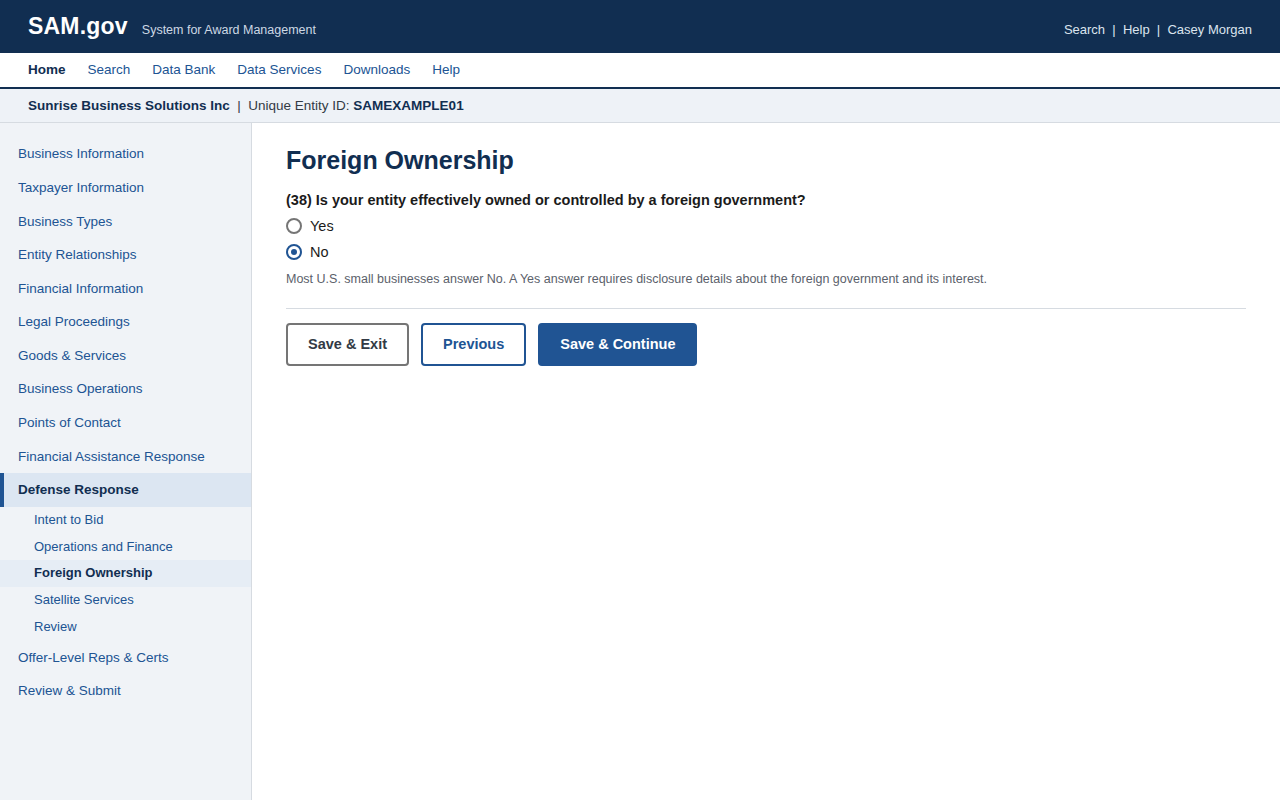
SAM.gov, Foreign Ownership page, Defense Response
A Yes or No DFARS representation question about foreign government ownership or control.
When you do this step for real, this is the screen waiting for you on the site. Read it over, then use the practice screen below to learn the step by doing it safely first.
“Is your entity effectively owned or controlled by a foreign government? (yes or no)” If yes, provide the name and contact information for someone at your entity who can answer questions about disclosure, plus the name and address of the entity or entities controlled by a foreign government, a description of interest, the ownership percentage, and the foreign government country.
The words above are the form text you will see, quoted from: FSD Entity Registration Checklist, Defense Response, question 38. The teaching in this lesson is written in our own words.Practice for Sunrise. Sunrise is owned by its U.S. founder. No foreign government owns or controls any part of it. Answer for Sunrise.
Pick one: Is your entity effectively owned or controlled by a foreign government?
A quick check on this one screen. Answer every question correctly to mark this screen complete. You can move on with Next at any time, finished or not, but the screen only counts as complete once its practice and this check are both done. You can try again if you miss one.
How is this question different from simply having a foreign owner or investor?
Sunrise is owned entirely by U.S. citizens, and no government of any country owns or controls any part of it. What does Sunrise answer here?
On the real question, answer only about foreign government ownership or control of your entity. Private foreign ownership is a different fact, handled on other screens; a Yes here opens detailed disclosure.
Screen 78: Satellite Services
Four related DFARS questions cover satellite services. They implement a prohibition on certain satellite services connected to covered foreign countries.
The questions circle two themes: a covered foreign country's government holding an ownership interest that can affect satellite operations, and launch or satellite services sourced from a covered foreign country.
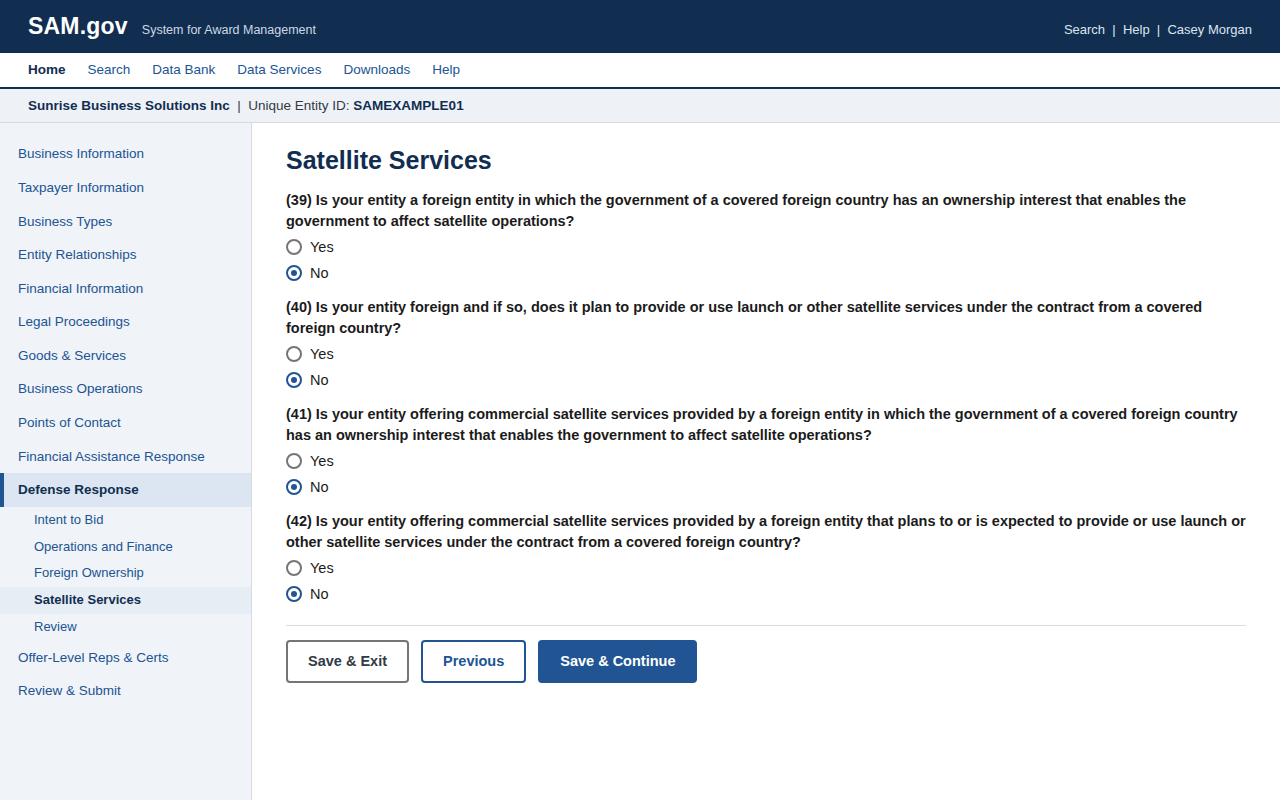
SAM.gov, Satellite Services page
Four Yes or No DFARS questions about foreign entities, covered foreign countries, and commercial satellite services.
When you do this step for real, this is the screen waiting for you on the site. Read it over, then use the practice screen below to learn the step by doing it safely first.
The four questions, in summary form: (39) your entity is a foreign entity in which a covered foreign country's government has an ownership interest enabling it to affect satellite operations; (40) your entity is foreign and plans to provide or use launch or other satellite services from a covered foreign country; (41) you offer commercial satellite services from such a foreign entity; (42) you offer commercial satellite services from a foreign entity that plans to provide or use launch or satellite services from a covered foreign country. Each is yes or no.
The words above are the form text you will see, quoted from: FSD Entity Registration Checklist, Defense Response, questions 39 to 42. The teaching in this lesson is written in our own words.Practice for Sunrise. Sunrise is a U.S. ambulance company with no satellite services of any kind. Pick the answer set that fits Sunrise.
Pick one: For a U.S. company with no satellite involvement, the four satellite questions are answered
A quick check on this one screen. Answer every question correctly to mark this screen complete. You can move on with Next at any time, finished or not, but the screen only counts as complete once its practice and this check are both done. You can try again if you miss one.
How many separate satellite questions are there, and what two themes run through them?
A domestic company has no satellite operations, offers no satellite services, and has no covered foreign country ties. How does it answer the four satellite questions?
On the real page, answer all four satellite questions individually. A company with no satellite involvement answers No to each one; they are answered, not left blank.
Screen 79: Defense Response: Review
The review screen for the Defense Response lists four sub-steps: Intent to Bid, Operations and Finance, Foreign Ownership, and Satellite Services, each with an Edit link.
A Defense Response Complete message confirms the section.
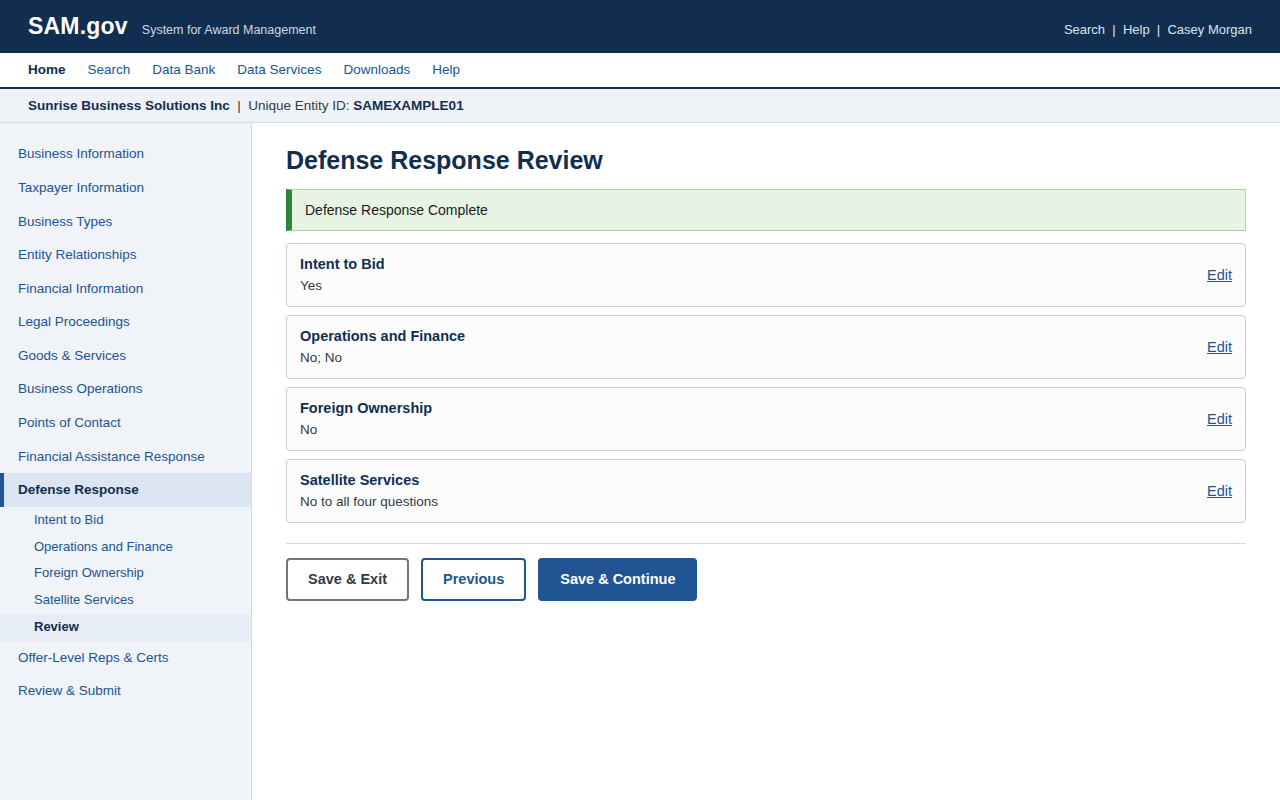
SAM.gov, Defense Response Review page
One row per sub-step with Edit, and the section completion confirmation.
When you do this step for real, this is the screen waiting for you on the site. Read it over, then use the practice screen below to learn the step by doing it safely first.
Practice the review. Check the four sub-steps.
Check each sub-step after reviewing it
A quick check on this one screen. Answer every question correctly to mark this screen complete. You can move on with Next at any time, finished or not, but the screen only counts as complete once its practice and this check are both done. You can try again if you miss one.
What four sub-steps are you confirming on this Review?
On the real review, confirm the four sub-steps match your real operations. If you answered No at the gateway, the rest should read Not Applicable.
Module complete Module Complete
Congratulations. You worked through every screen in this module, practiced each one with the example company, and passed the check on each screen.
Here is what you covered:
- Screen 74: Defense Response: Section intro
- Screen 75: Intent to Bid
- Screen 76: Operations and Finance
- Screen 77: Foreign Ownership (Defense Response)
- Screen 78: Satellite Services
- Screen 79: Defense Response: Review
The Defense Response is complete. Next, the Offer-Level Representations and Certifications, the answers that travel with your offers.
Pulse Academy | GovCon Mastery Tool. This lesson teaches the registration path. SAM.gov, Login.gov, and the Federal Service Desk are official government services; Pulse Academy is not part of any government agency, and no agency endorses this training.