Back to all modules Definitions: common terms, defined Search the tool
Pulse Academy | GovCon Mastery Tool
SAM Registration: Offer-Level Representations and Certifications
SAM screens 80 to 87 of 92. One screen at a time: see it, learn it, practice it, then answer the screen check to mark the screen complete. Back and Next always work, so you can move in any order.
Screen 80: Offer-Level Reps and Certs: Section intro
This section holds the FAR (Federal Acquisition Regulation) representations and certifications that attach at the offer level. Your answers here become part of your registration record.
When you submit an offer on a covered solicitation, these answers speak for your company. That is why the section sits near the end: it is the voice your offers will use.
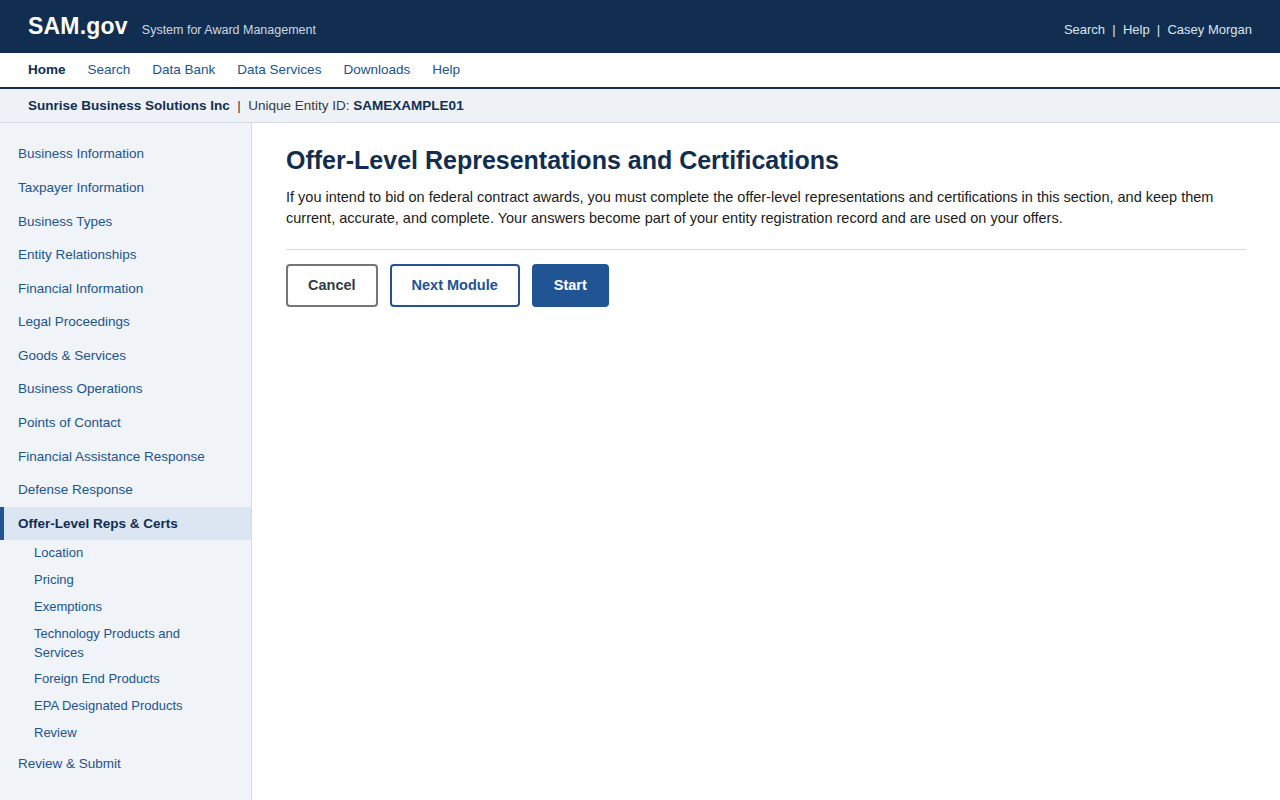
SAM.gov, Offer-Level Representations and Certifications intro page
Intro text explaining that these FAR representations and certifications are part of the registration record and apply to offers.
When you do this step for real, this is the screen waiting for you on the site. Read it over, then use the practice screen below to learn the step by doing it safely first.
Practice the definition. Read the scenario and pick the right classification.
Sunrise Business Solutions Inc was incorporated in Indiana, has always operated in Indiana, and has never moved offshore or shifted ownership abroad. Is Sunrise an inverted domestic corporation?
A quick check on this one screen. Answer every question correctly to mark this screen complete. You can move on with Next at any time, finished or not, but the screen only counts as complete once its practice and this check are both done. You can try again if you miss one.
What makes your answers in this section different from the entity-level sections?
A corporation was formed in the United States, has always operated here, and has never shifted ownership offshore. How does it answer the two inverted domestic corporation questions in this section?
On the real intro, learn the inverted domestic corporation definition before you answer questions 27 and 28 in this section. An ordinary U.S. small business that has never moved offshore answers No to both.
Screen 81: Location
This page asks about your physical locations: whether you have other plants or facilities besides your main address, and whether your main address sits in a Labor Surplus Area.
A Labor Surplus Area is an area the Department of Labor designates as having high unemployment, a fact that matters on certain solicitations.
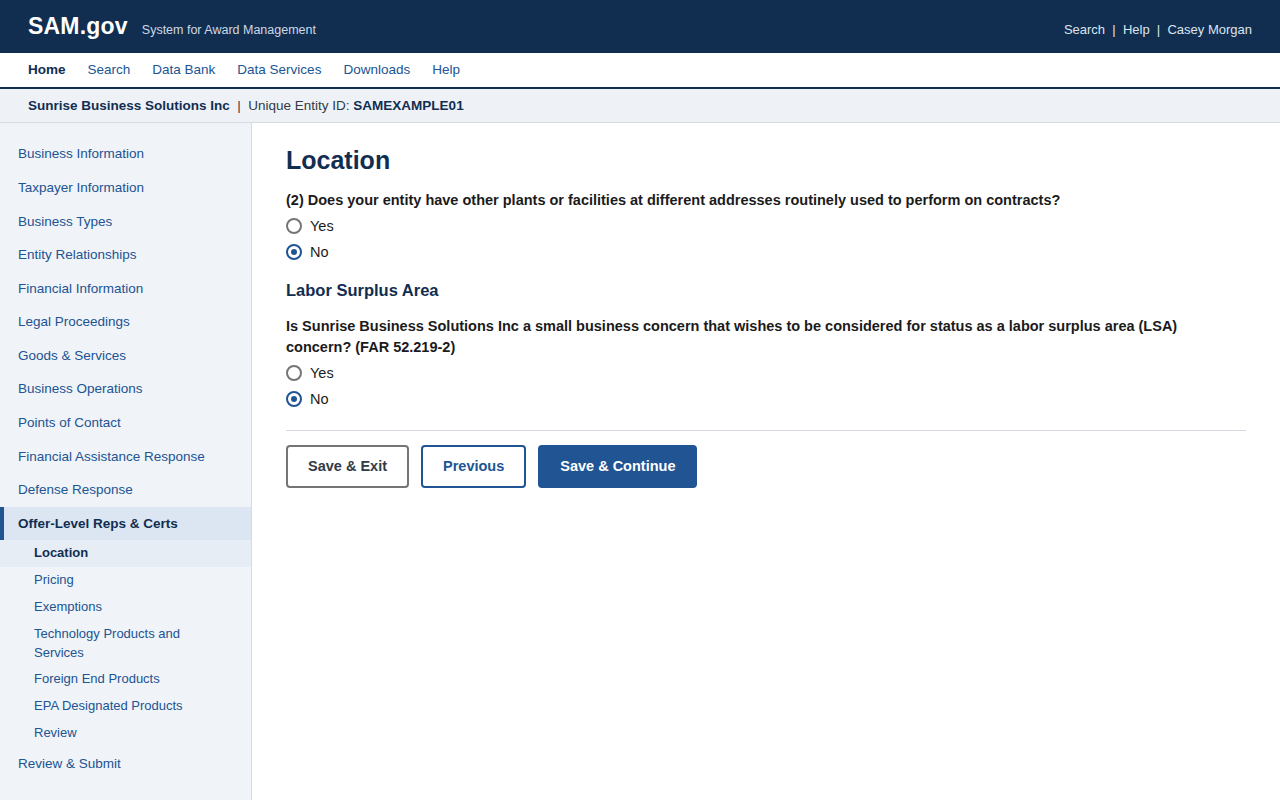
SAM.gov, Location page
Two Yes or No questions: other plants or facilities, and Labor Surplus Area status of the main address.
When you do this step for real, this is the screen waiting for you on the site. Read it over, then use the practice screen below to learn the step by doing it safely first.
“Do you have other plants/facilities, in addition to your main address? (yes or no)” If yes, provide the address, owner name, and owner address for each. And: “Is your main address in a Labor Surplus Area (LSA)? (yes or no)”
The words above are the form text you will see, quoted from: Federal Service Desk (FSD) Entity Registration Checklist, Offer-Level Representations and Certifications, items 2 and 5. The teaching in this lesson is written in our own words.Practice for Sunrise. Sunrise operates from its single main address, with no other plants or facilities, and its main address is not in a Labor Surplus Area. Answer both questions for Sunrise.
Pick one: Do you have other plants/facilities, in addition to your main address?
Pick one: Is your main address in a Labor Surplus Area (LSA)?
A quick check on this one screen. Answer every question correctly to mark this screen complete. You can move on with Next at any time, finished or not, but the screen only counts as complete once its practice and this check are both done. You can try again if you miss one.
If you answer Yes to other plants or facilities, what must you provide for each one?
Your company operates from one address only, its main address. What is your answer to the other plants or facilities question?
On the real page, answer from your records: list every additional plant or facility with its address and owner details if you have any, and check the published Labor Surplus Area designations instead of guessing about your main address.
Screen 82: Pricing
This page asks how your company determines prices: the name and title of the person responsible for determining prices offered to the Government, and whether your offered prices are based on established catalog or market prices.
It also asks whether you include the cost of equipment maintenance in your prices.
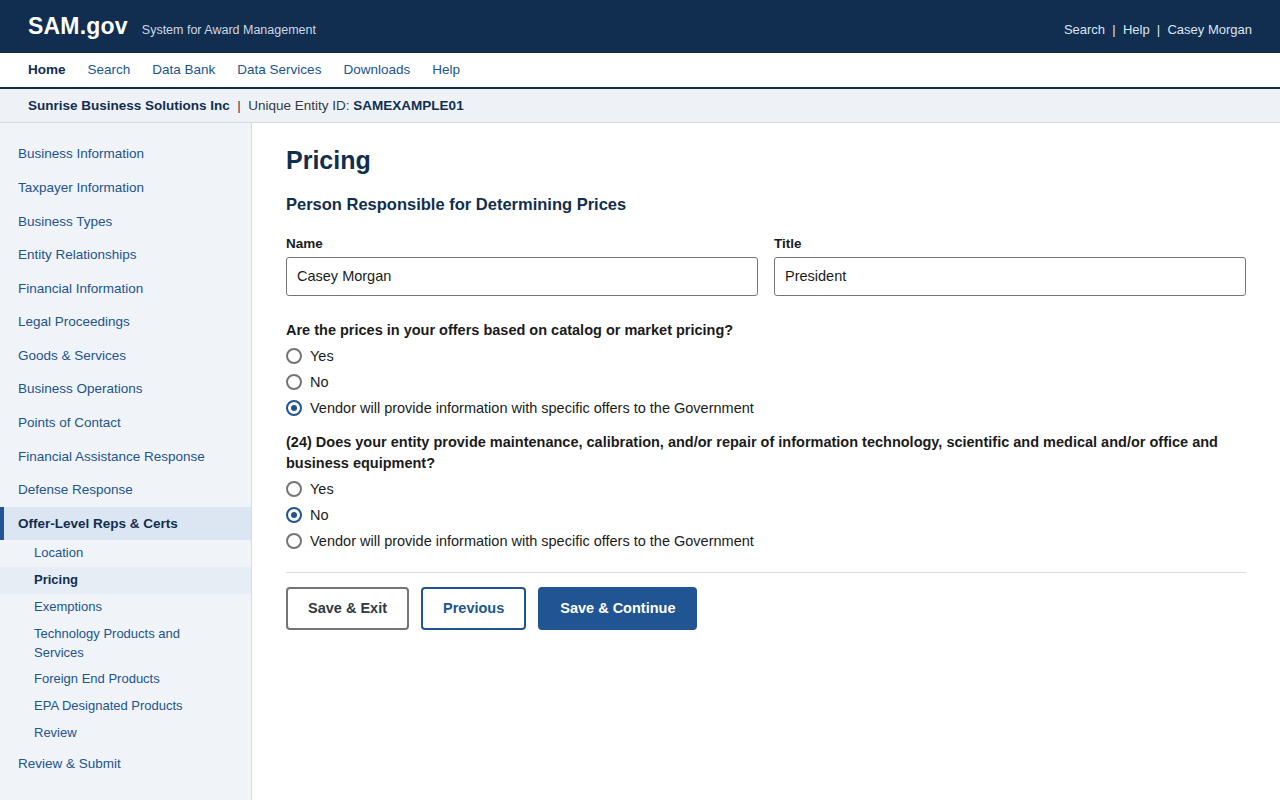
SAM.gov, Pricing page
Fields for the price determination person's name and title, a Yes or No on catalog or market based pricing, and a Yes or No on equipment maintenance in prices.
When you do this step for real, this is the screen waiting for you on the site. Read it over, then use the practice screen below to learn the step by doing it safely first.
Practice for Sunrise. Casey Morgan, the president, determines Sunrise's prices. Sunrise does not include equipment maintenance costs in its prices. Fill in both parts.
Pick one: Do you include the cost of equipment maintenance in your prices?
A quick check on this one screen. Answer every question correctly to mark this screen complete. You can move on with Next at any time, finished or not, but the screen only counts as complete once its practice and this check are both done. You can try again if you miss one.
What does choosing Vendor will provide information with specific offers to the Government actually commit you to?
Your company's offered prices come straight from its published price list, the same list any customer can see. How are those prices best described on this page?
On the real page, name the real person with authority over your prices, with their title. Choose the catalog or market price answer that matches how you truly price, and remember that providing information with specific offers is a promise to do exactly that.
Screen 83: Exemptions
This page asks about the Service Contract Labor Standards, called SCLS, exemption. SCLS is the federal rule setting labor standards on service contracts.
The question offers three answers: your entity claims the exemption, does not claim it, or has not decided yet.
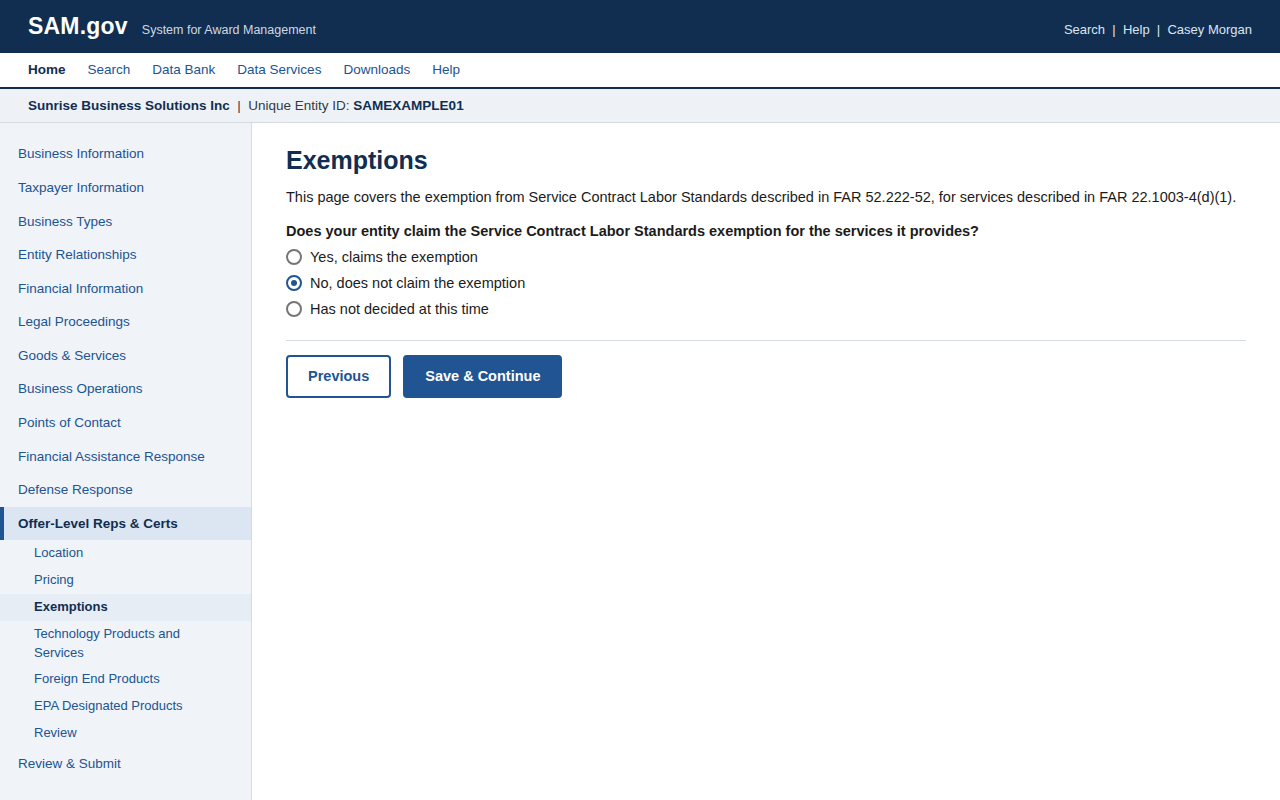
SAM.gov, Exemptions page
The SCLS exemption question with three choices: claims the exemption, does not claim the exemption, or has not decided at this time.
When you do this step for real, this is the screen waiting for you on the site. Read it over, then use the practice screen below to learn the step by doing it safely first.
“Does your entity claim the Service Contract Labor Standards (SCLS) exemption? (check one)” Options: Yes, your entity claims the exemption; No, your entity does not claim the exemption; Has not decided at this time.
The words above are the form text you will see, quoted from: FSD Entity Registration Checklist, Offer-Level Representations and Certifications, item 25. The teaching in this lesson is written in our own words.Practice the option most members miss. The scenario: a company has never evaluated the SCLS exemption and its owner is not sure what claiming it would mean. Pick the answer that fits that company.
Pick one: Does your entity claim the Service Contract Labor Standards (SCLS) exemption?
A quick check on this one screen. Answer every question correctly to mark this screen complete. You can move on with Next at any time, finished or not, but the screen only counts as complete once its practice and this check are both done. You can try again if you miss one.
What three answers does the SCLS exemption question offer?
Your company has genuinely never evaluated whether it claims the SCLS exemption. What is the honest answer to record today?
On the real question, record your true position on the SCLS exemption: claims it, does not claim it, or has not decided at this time. If you later decide, update the registration.
Screen 84: Technology Products and Services
This page covers two topics: limited rights data, and covered telecommunications equipment and services.
Limited rights data is technical data the government receives with restricted rights. Covered telecommunications refers to specific equipment and services the law restricts because of security concerns.
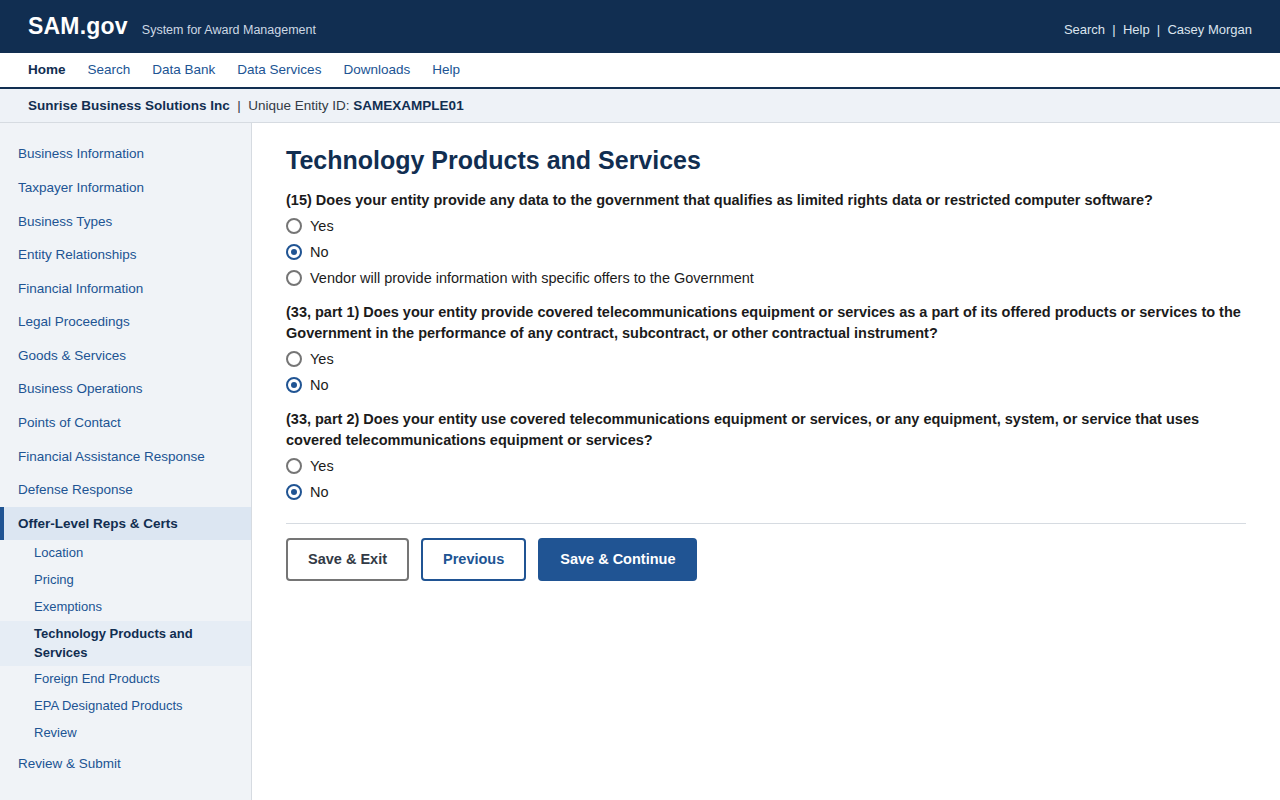
SAM.gov, Technology Products and Services page
Yes or No questions on asserting limited rights in data, and the two part covered telecommunications representation.
When you do this step for real, this is the screen waiting for you on the site. Read it over, then use the practice screen below to learn the step by doing it safely first.
Practice for Sunrise. Sunrise asserts no limited rights in data, provides no covered telecommunications equipment or services, and uses none. Answer all three questions for Sunrise.
Pick one: Does your entity assert limited rights in technical data?
Pick one, part 1: Does your entity provide covered telecommunications equipment or services to the Government?
Pick one, part 2: Does your entity use covered telecommunications equipment or services?
A quick check on this one screen. Answer every question correctly to mark this screen complete. You can move on with Next at any time, finished or not, but the screen only counts as complete once its practice and this check are both done. You can try again if you miss one.
What is the difference between part 1 and part 2 of the covered telecommunications question?
A company sells no telecommunications equipment, but after checking, it finds covered telecommunications equipment running inside its own office network. What are its honest answers?
On the real page, answer the two telecommunications parts separately: whether you provide covered equipment or services to the government, and whether you use any in your own operations. Check what equipment your company actually runs before answering No.
Screen 85: Foreign End Products and Services
This page asks whether you provide foreign end products or services, meaning products or services from outside the United States, and about a specific labor list under Executive Order 13126.
That Executive Order concerns products made with forced or indentured child labor. The question asks whether any products you provide appear on that list.
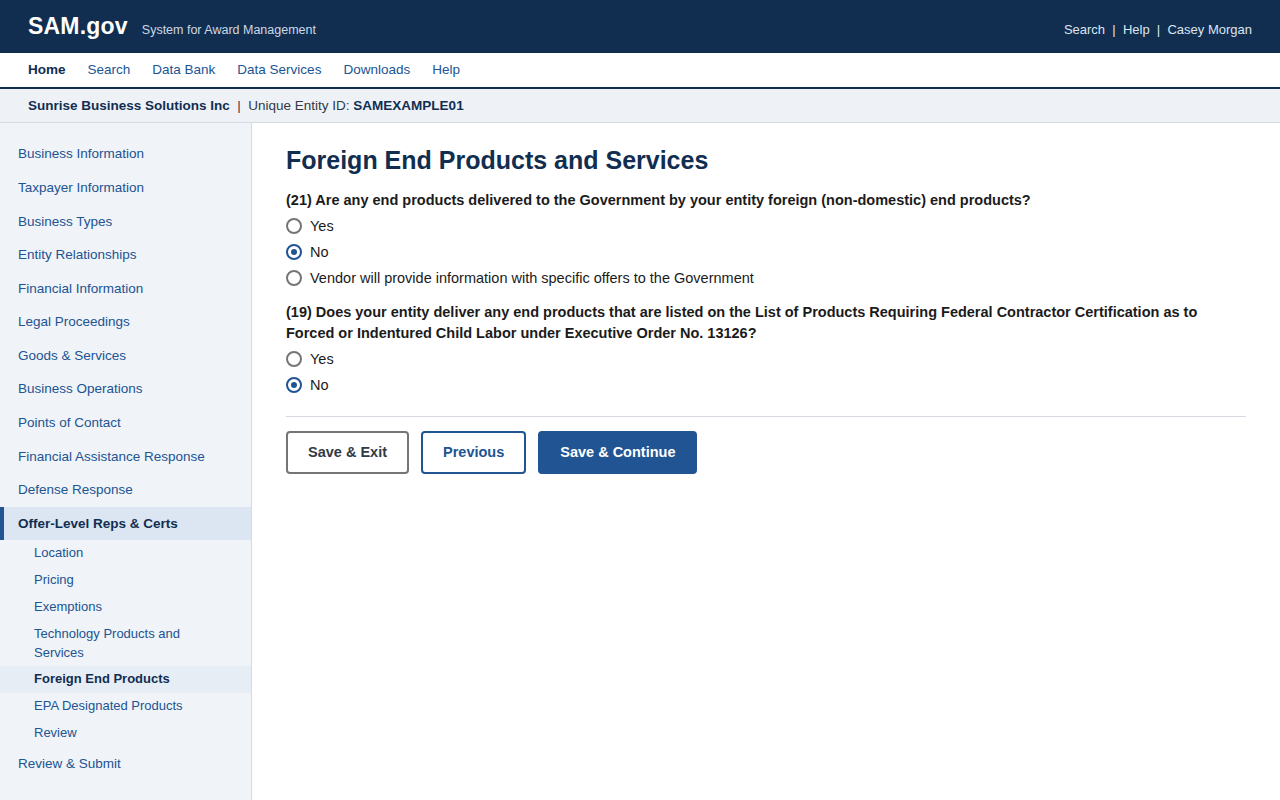
SAM.gov, Foreign End Products and Services page
Yes or No questions on foreign end products and services, and on Executive Order 13126 listed products.
When you do this step for real, this is the screen waiting for you on the site. Read it over, then use the practice screen below to learn the step by doing it safely first.
“Do you provide any foreign end products or services? (yes or no)” If yes, list each product and its country of origin. And: “Are any end products that you provide listed on the List of Products Requiring Contractor Certification as to Forced or Indentured Child Labor under Executive Order 13126? (yes or no)”
The words above are the form text you will see, quoted from: FSD Entity Registration Checklist, Offer-Level Representations and Certifications, items 21 and 19. The teaching in this lesson is written in our own words.Practice for Sunrise. Sunrise provides U.S. ambulance services performed in the United States, and nothing it provides appears on the Executive Order 13126 list. Answer both questions for Sunrise.
Pick one: Do you provide any foreign end products or services?
Pick one: Are any end products that you provide listed on the Executive Order 13126 list?
A quick check on this one screen. Answer every question correctly to mark this screen complete. You can move on with Next at any time, finished or not, but the screen only counts as complete once its practice and this check are both done. You can try again if you miss one.
If you answer Yes to providing foreign end products, what follow-up information is required?
A U.S. company provides only services, performed inside the United States, and nothing it provides is on the Executive Order 13126 list. What does it answer to the foreign end products question?
On the real page, answer from what you actually supply. If you provide foreign end products, list each one with its country of origin, and answer the Executive Order 13126 question from your real offerings.
Screen 86: EPA Designated Products
This page asks about EPA designated products: products the Environmental Protection Agency designates for preferred purchasing because they contain recovered materials.
The rule behind it comes from the Resource Conservation and Recovery Act, and the designated products are listed in the Code of Federal Regulations, called the CFR.
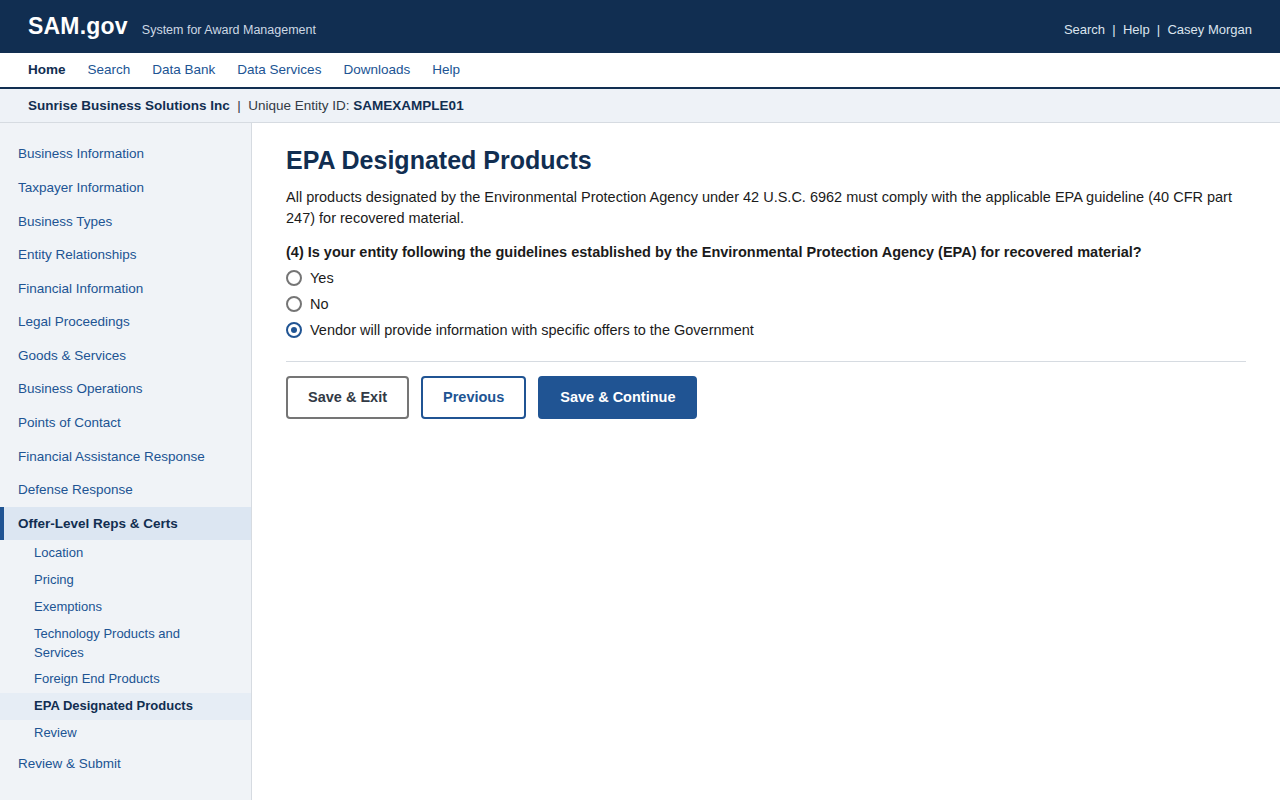
SAM.gov, EPA Designated Products page
The question whether you provide EPA designated products, with a choice to provide the information with specific offers.
When you do this step for real, this is the screen waiting for you on the site. Read it over, then use the practice screen below to learn the step by doing it safely first.
“Do you provide EPA-designated products? (check one)” Options include Yes, No, and Vendor will provide information with specific offers to the Government. The designated products are those listed in 40 CFR part 247, under 42 U.S.C. 6962, the Resource Conservation and Recovery Act.
The words above are the form text you will see, quoted from: FSD Entity Registration Checklist, Offer-Level Representations and Certifications, item 4. The teaching in this lesson is written in our own words.Practice for Sunrise. Sunrise is a services firm; it sells ambulance services, not products. Pick the answer that fits a services firm.
Pick one: Do you provide EPA-designated products?
A quick check on this one screen. Answer every question correctly to mark this screen complete. You can move on with Next at any time, finished or not, but the screen only counts as complete once its practice and this check are both done. You can try again if you miss one.
What does EPA designated mean for a product?
A firm sells professional services and no products at all. Which answer on this page fits it, and why?
On the real page, answer from your real catalog. A services firm typically provides the information with specific offers to the Government; a products company answers for the designated products it actually provides.
Screen 87: Offer-Level Reps and Certs: Review
The review screen for this section lists its sub-steps: Location, Pricing, Exemptions, Technology Products and Services, and Foreign End Products and Services, each with an Edit link.
An Offer-Level Representations and Certifications Complete message confirms the section.
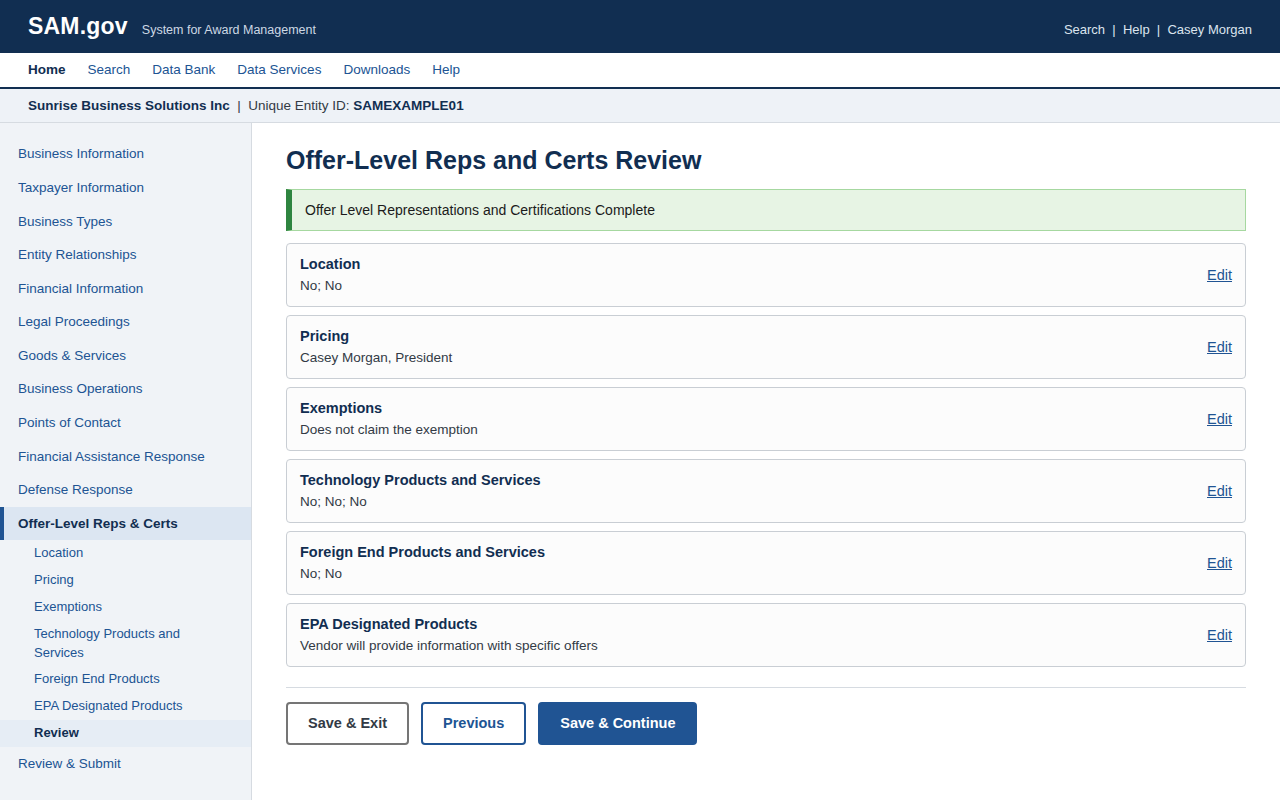
SAM.gov, Offer-Level Reps and Certs Review page
One row per sub-step with Edit, and the section completion confirmation.
When you do this step for real, this is the screen waiting for you on the site. Read it over, then use the practice screen below to learn the step by doing it safely first.
Practice the review. Check the five sub-steps.
Check each sub-step after reviewing it
A quick check on this one screen. Answer every question correctly to mark this screen complete. You can move on with Next at any time, finished or not, but the screen only counts as complete once its practice and this check are both done. You can try again if you miss one.
What five sub-steps are you confirming on this Review?
On the real review, read the five sub-steps as sworn positions on your future offers. Fix any answer that was a guess before you continue.
Conditional Step: Architect-Engineer Response (SF 330 Part II)
One section of the Representations and Certifications appears only for some companies: the Architect-Engineer Response. SAM.gov, the System for Award Management, shows it when your NAICS (North American Industry Classification System) list includes architecture or engineering codes.
If your company has no architecture or engineering codes, you will never see this section, and nothing about it belongs in your registration. Sunrise, an ambulance company, never sees it. This step exists so the companies it does apply to are not surprised by it.
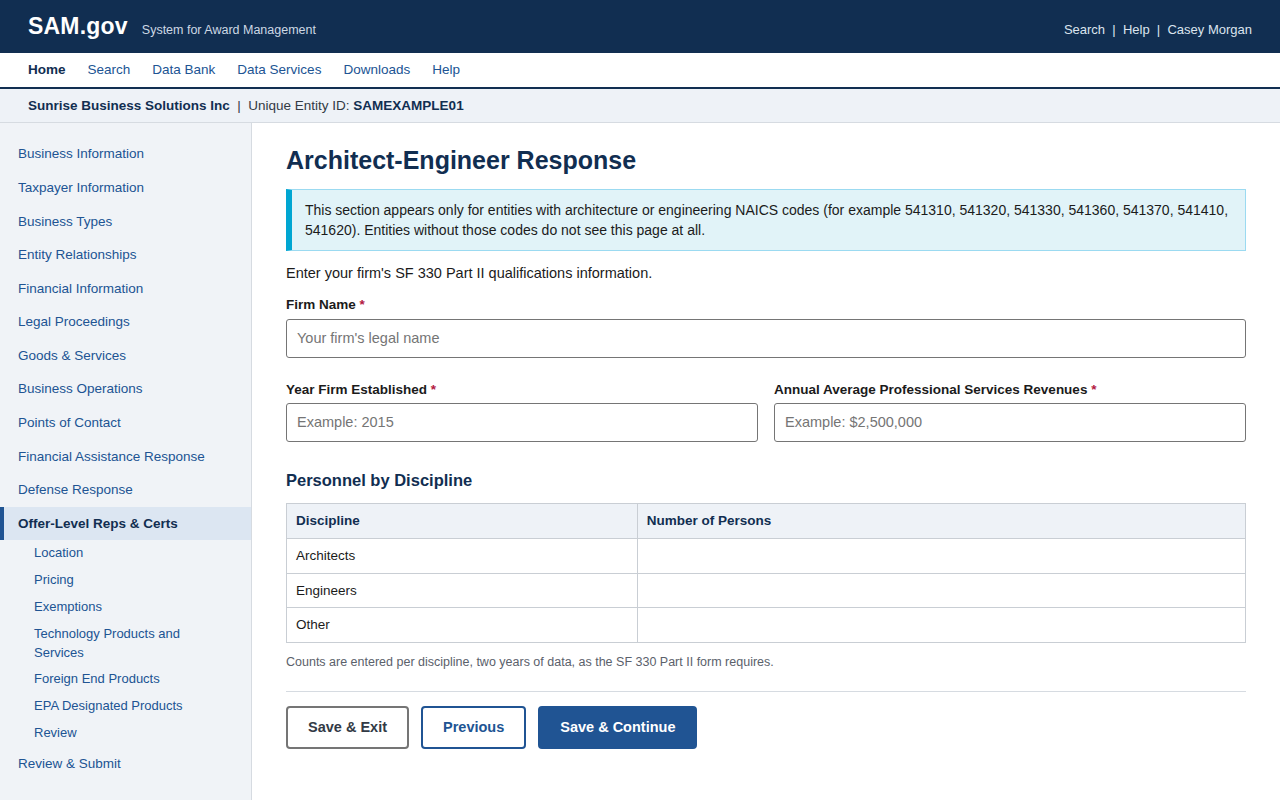
SAM.gov, Architect-Engineer Response page
For entities with architecture or engineering NAICS codes, this page asks for the firm's SF 330 Part II qualifications information. Entities without those codes do not see this page at all.
When you do this step for real, this is the screen waiting for you on the site. Read it over, then use the practice screen below to learn the step by doing it safely first.
Practice the gateway recognition. Sunrise is an ambulance company whose only NAICS code is 621910. Answer for Sunrise first, then for a firm that does engineering work.
Pick one: Sunrise's NAICS list contains only 621910, Ambulance Services. Will the Architect-Engineer Response section appear in Sunrise's registration?
Pick one: A firm whose NAICS list includes 541330, Engineering Services, reaches the Representations and Certifications. What should it expect?
A quick check on this one screen. Answer every question correctly to mark this screen complete. You can move on with Next at any time, finished or not, but the screen only counts as complete once its practice and this check are both done. You can try again if you miss one.
Which companies see the Architect-Engineer Response section?
What is the SF 330 Part II?
On the real registration, this section appears only if your NAICS list includes architecture or engineering codes. If it appears for you, complete it from your firm's qualifications records. If your company performs no A-E work, you will never see it, and there is nothing to do.
Module complete Module Complete
Congratulations. You worked through every screen in this module, practiced each one with the example company, and passed the check on each screen.
Here is what you covered:
- Screen 80: Offer-Level Reps and Certs: Section intro
- Screen 81: Location
- Screen 82: Pricing
- Screen 83: Exemptions
- Screen 84: Technology Products and Services
- Screen 85: Foreign End Products and Services
- Screen 86: EPA Designated Products
- Screen 87: Offer-Level Reps and Certs: Review
- Conditional step: Architect-Engineer Response (SF 330 Part II)
Your offer level answers are recorded and will travel with your offers. Next, the last module: Review and Submit, where the whole registration is checked, certified, and sent.
Pulse Academy | GovCon Mastery Tool. This lesson teaches the registration path. SAM.gov, Login.gov, and the Federal Service Desk are official government services; Pulse Academy is not part of any government agency, and no agency endorses this training.